The Horizon
The Choice
In October 1994, at the OOPSLA conference in Portland, Oregon, four computer scientists did something that would shape software engineering for the next three decades and counting.
Erich Gamma, Richard Helm, Ralph Johnson, and John Vlissides published Design Patterns: Elements of Reusable Object-Oriented Software. They didn't invent a new language. They didn't build a framework. They didn't release an open-source tool. They did something simpler and more lasting.
They named things.
Factory. Observer. Strategy. Decorator. Singleton. Twenty-three names for twenty-three recurring solutions. Before their book, every developer who discovered one of these patterns had to explain it from scratch every time — in design reviews, in pull request comments, in architecture documents. After their book, you could say "use a Strategy pattern here" and your entire team understood immediately. The name compressed a paragraph of explanation into two words.
Over 500,000 copies sold. Fourteen languages. The ACM SIGPLAN awarded them the Programming Languages Achievement Award in 2005 — recognizing the impact of their work "on programming practice and programming language design." In 2026, thirty-two years after publication, those patterns are embedded in Java's standard library, Spring's dependency injection, .NET's event system, Android's view hierarchy, and React's component lifecycle.30Gang of Four. Design Patterns. 1994. 500,000+ copies, 14 languages. Wikipedia
The Gang of Four didn't make OOP work. They made it learnable. They compressed decades of hard-won experience into transmissible knowledge that crossed language barriers, company boundaries, and generation gaps.
Where we are
Every paradigm goes through five phases. Agent composition is in Phase 2.
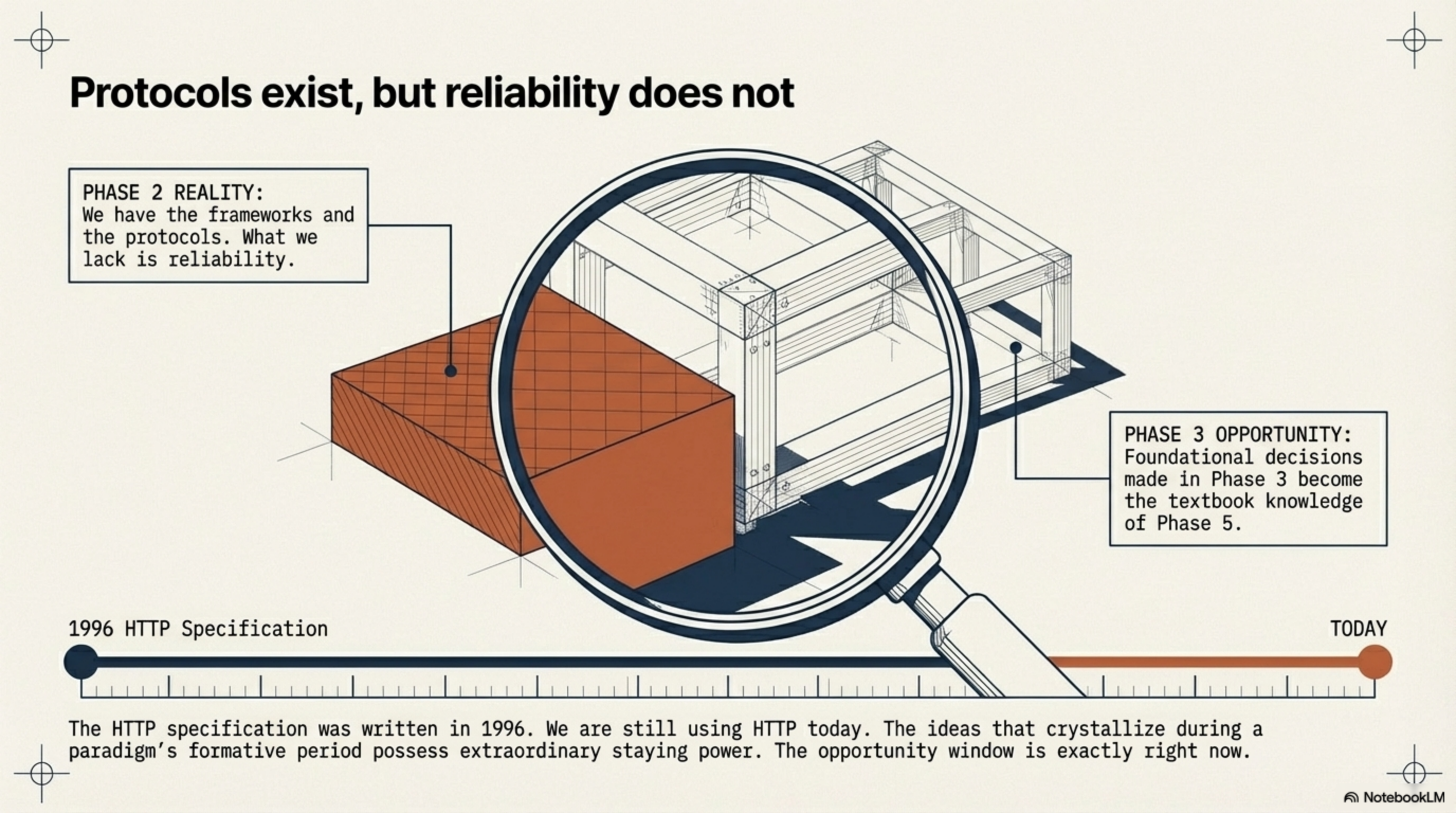
We are in Phase 2. The protocols exist — MCP and A2A under the Linux Foundation. The frameworks exist — OpenClaw, Superpowers, Claude Code. The reliability doesn't.
Phase 3 is when the foundational decisions get made. The patterns named in Phase 3 become the textbook knowledge of Phase 5. The ideas that crystallize during a paradigm's formative period have extraordinary staying power.
The opportunity window is Phase 2 and Phase 3. Right now.
What to do
Build with agents. Get your hands dirty. Composition failures aren't setbacks — they're the data that feeds the trajectory flywheel.
Document what works and what doesn't. Your trajectory logs are a gold mine that nobody is mining systematically yet.
Share your patterns. The community needs vocabulary before it needs frameworks. A named pattern is worth a thousand lines of documentation.
Build observability first. Trajectory capture, replay, evaluation, cost tracking, anomaly detection. This is not infrastructure you add later. It's the foundation everything else depends on.
And stop waiting for someone else to write the engineering discipline for agent composition. The Gang of Four didn't wait. They observed. They named. They published. And they shaped thirty-two years of software.
The choice
Every paradigm shift in the history of software creates a temporary window where the rules haven't been written yet. Where an individual engineer with the right insight can have outsized impact. Where the game isn't "learn the established framework" but "create the framework others will learn."
We are in that window.
The Specialist Ensemble. The Verification Loop. The Skill Mesh. The Escalation Chain. The Context Funnel. The Consensus Protocol. The Trajectory Replay. The AGENT principles — Autonomy Boundaries, Governed Composition, Explicit Observability, Narrowest Capable Agent, Trajectory-Driven Improvement.
These are a first attempt at that vocabulary. They're incomplete. They'll evolve. Some might be wrong. But they're a start — and starting is what matters when the rules are unwritten.
The people who name the patterns
own the conversation for decades.
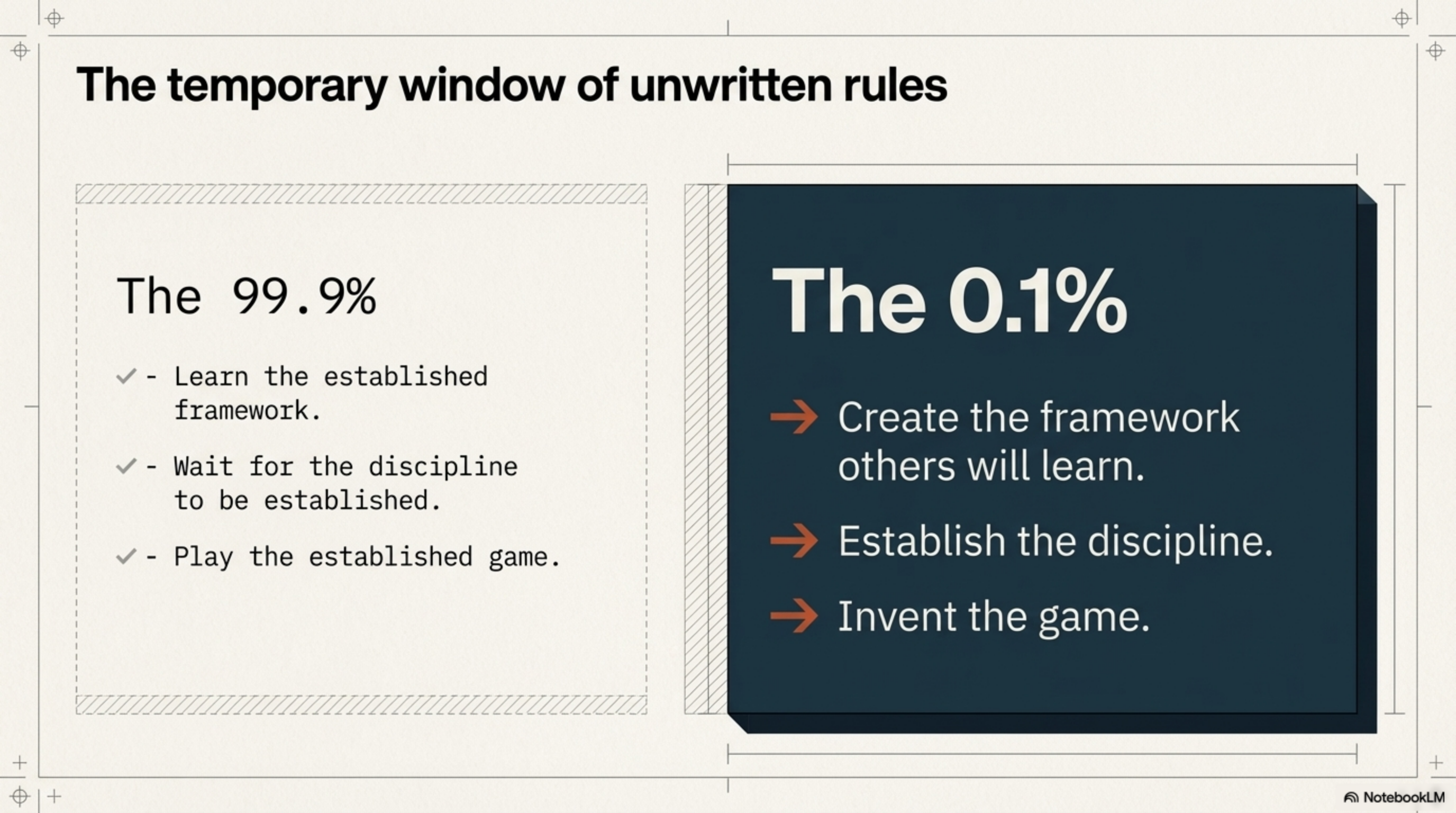
The 99.9% will learn the discipline after it's established.
The 0.1% will establish it.
The staircase has one more step.
Nobody has finished building it.
Now you have the blueprint.