The Operating System
Here is a question that reveals where the money goes in every era of software.
In the age of objects, who captured more value — the developer who wrote Java classes, or Sun Microsystems, who built the JVM that ran them?
In the age of services, who captured more value — the startup that built a clever REST API, or Amazon, who built the cloud platform that hosted it?
The answer is the same. Every time. For forty years.
Value accrues to the orchestration layer.
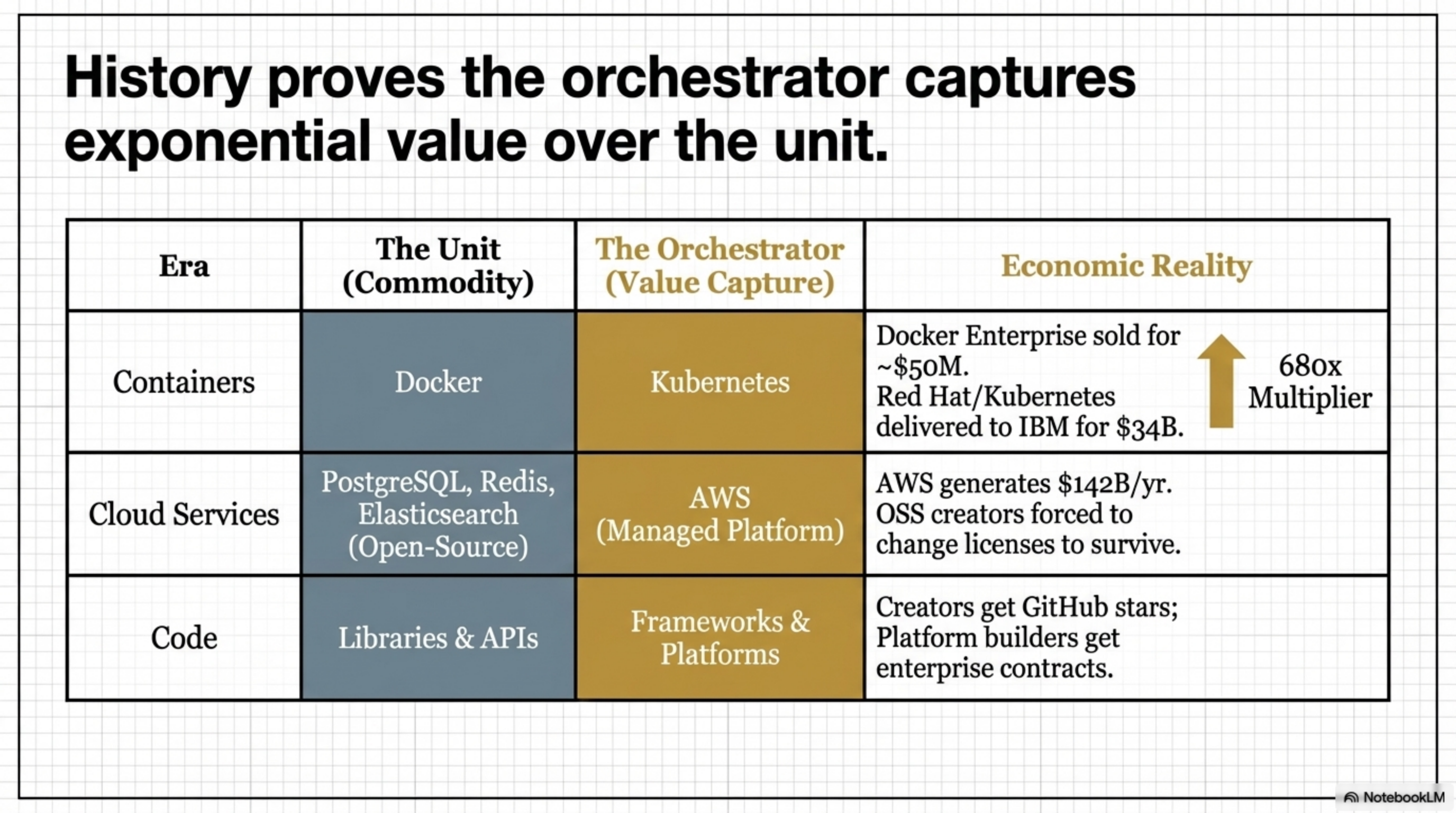
Docker created containerization — the most important infrastructure innovation of the 2010s. Docker Enterprise sold to Mirantis in 2019 for roughly $50 million. Kubernetes — the orchestration layer that schedules, scales, and manages containers — delivered Red Hat to IBM for $34 billion. The orchestrator was worth 680 times more than the unit it orchestrated.
AWS generated $142 billion in annualized revenue by Q4 2025, running managed services on top of open-source projects like PostgreSQL, Redis, and Elasticsearch. The open-source creators earned a fraction of that. Elastic NV and Redis Labs had to change their licenses specifically because AWS was extracting more value from their software than they were.15AWS Q4 2025: $35.6B quarterly. CNBC
Library authors get GitHub stars. Framework authors get billions. API builders get usage fees. Platform builders get enterprise contracts. The pattern is brutally consistent.
In the agent era, the orchestration layer has a name. It's called the harness.
The harness flywheel
Philipp Schmid — one of the clearest thinkers on agent infrastructure, formerly at Hugging Face — published his thesis in early 2026: "Competitive advantage is no longer the prompt, but the trajectories your harness captures."16Schmid, P. "The Importance of Agent Harness in 2026." philschmid.de
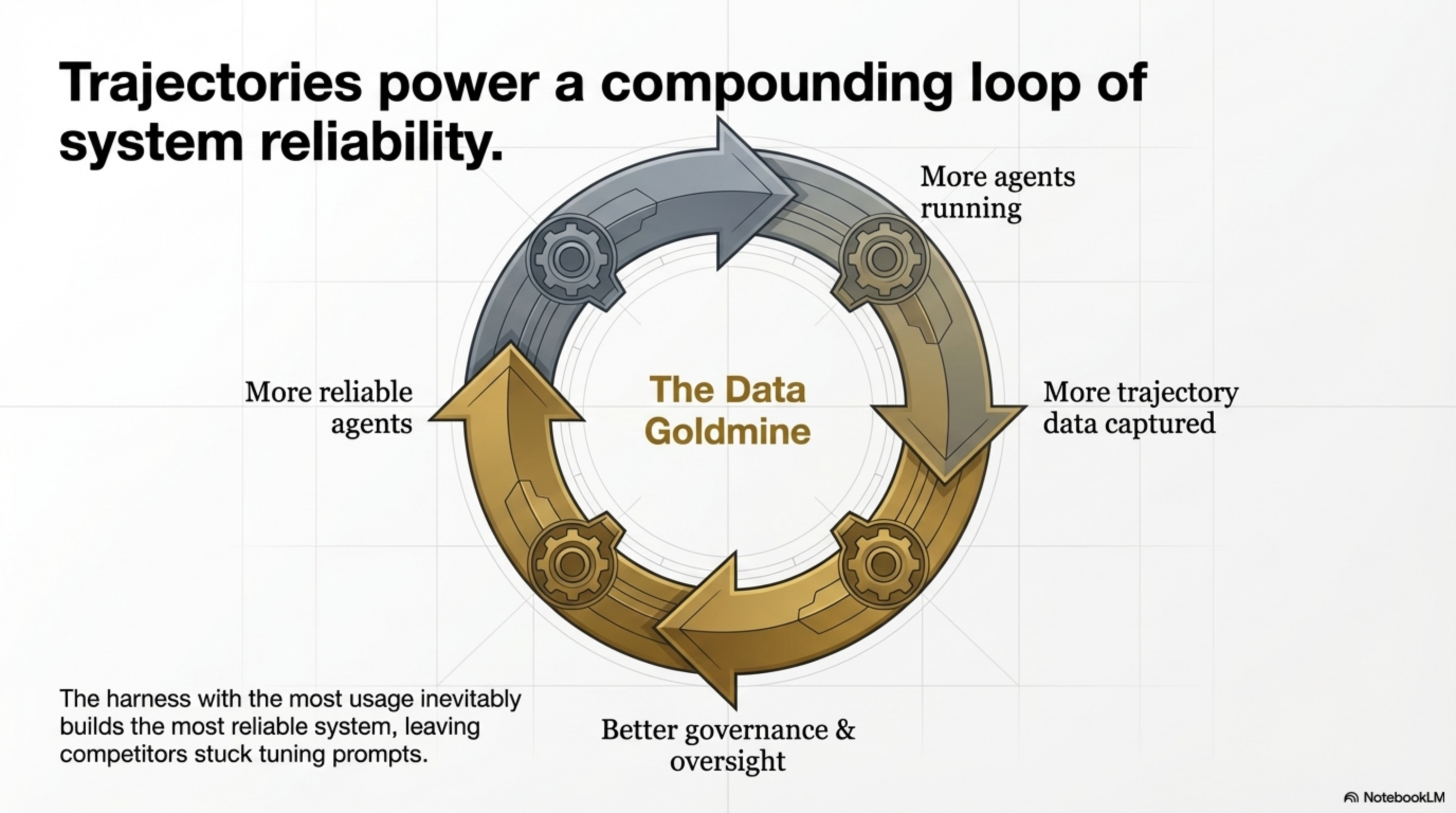
Every time an agent runs inside a harness, the harness produces a trajectory — a complete record of what tools were called, what decisions were made, where failures occurred, and what the human approved or rejected. This data is gold.
Trajectories become the training set for better governance rules. Better governance produces more reliable agents. More reliable agents attract more usage. More usage produces more trajectories.
Manus — the autonomous agent that went viral in early 2025 — spent six months and five complete architectural rewrites on their harness before reaching production quality. The underlying model didn't change during those six months. The harness did. Five times. The engineering challenge wasn't intelligence. It was governance infrastructure.
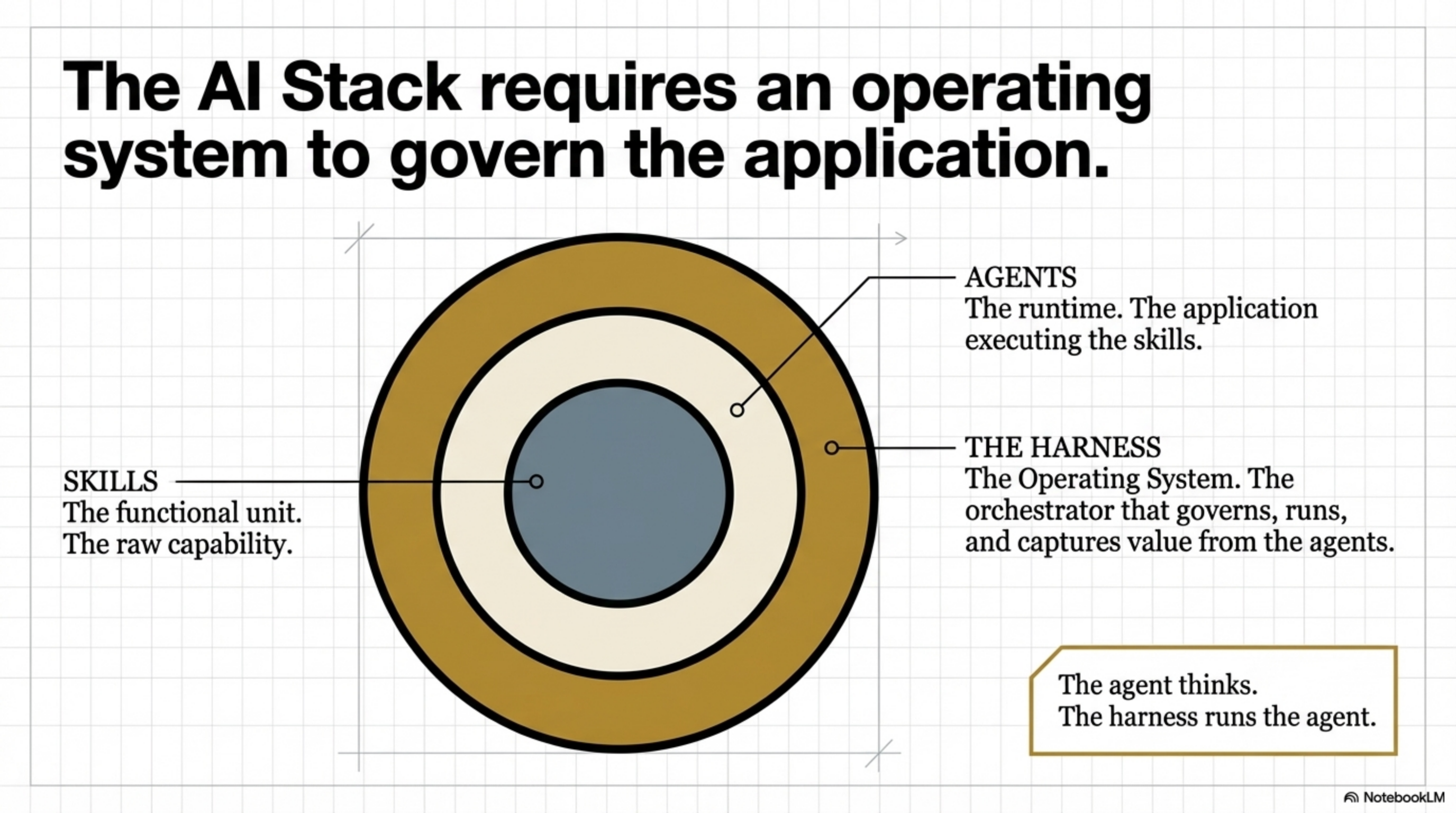
The agent thinks. The harness runs the agent.
The agent is the application. The harness is the operating system.
My harness currently captures:
Your harness is either capturing trajectory data that compounds into a competitive advantage, or it's not — and you're flying blind while competitors build their flywheel. Check each capability. Every "false" is a gap in your operating system.
// AUDIT HARNESS CAPABILITIES
captures_actions = true | false
captures_tool_calls = true | false
captures_reasoning = true | false
captures_costs = true | false
captures_human_decisions = true | false
captures_failures = true | false
// Each false is a missing input to your trajectory flywheel.